

Types of food flavorings
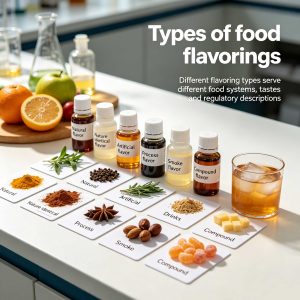
H1: Types of Food Flavorings
Food flavorings are indispensable aromatic raw materials that enrich the taste of all food products. To help food manufacturers select matching essences accurately according to production demands, this article sorts out the mainstream types of food flavorings. It classifies them based on extraction sources, physical forms and application mediums, and elaborates on their respective characteristics and suitable food production scenarios.
H2: Classification by Raw Material Source
First of all, natural food flavorings are extracted from fresh fruits, plants, spices and animal tissues through squeezing, distillation or spray drying. They deliver soft, genuine natural aroma and match clean-label high-end food formulas.
Meanwhile, nature-identical synthetic flavorings simulate natural aromatic molecules via precise laboratory blending. Their aroma performance is stable, and batch consistency is excellent for large-scale mass food production.
Besides, artificial food flavorings adopt safe synthetic monomers that do not exist in natural raw materials, creating unique trendy taste styles with ultra-low procurement costs.
Furthermore, biotech fermented flavorings rely on microbial fermentation to generate mellow aged notes, widely applied in savory snacks, yogurt and compound seasonings.
H2: Classification by Physical Form of Flavorings
To start with, liquid food flavorings include oil-soluble, water-soluble and alcohol-based essence. They dissolve fast in liquid beverages, ice cream bases and marinade sauces without agglomeration.
Consequently, liquid flavors are the most universal type for cold drinks, soda and liquid condiment production lines.
In addition, powder concentrated flavorings are made by spray-drying concentrated fruit juice or spice extracts. They mix evenly with solid raw materials such as candy powder, meal replacement powder and baking premixes.
On top of that, microcapsule embedded flavorings wrap aromatic substances with food-grade wall materials. They lock fragrance effectively and resist high-temperature processing and long-term storage aroma loss.
H2: Classification by Applicable Production Medium
H3: Water-soluble food flavorings
For one thing, they dissolve completely in aqueous systems such as fruit juice, cold tea, sparkling soda and solid drink sachets. They maintain stable fruity aroma under acidic low-pH beverage environments.
For another, they feature light refreshing taste without greasy feeling, ideal for all kinds of cold and hot beverage product development.
H3: Oil-soluble food flavorings
Meanwhile, oil-based flavors blend seamlessly with cream, butter, edible oil and chocolate substrates. They are the core raw material for ice cream, baked pastries, chocolate and fried food coating seasonings.
H3: Emulsified & compound food flavorings
In addition, emulsified flavorings can disperse evenly in both water and oil mediums. They are multi-purpose essences suitable for compound beverages, dairy desserts and composite condiment production.
H2: Matching Tips for Different Types of Food Flavorings
Above all, choose natural powder flavorings if you develop organic clean-label solid food such as meal replacement powder and baked cookies.
In addition, select oil-soluble liquid flavoring for chocolate, ice cream and fried food mass production to retain complete aroma during thermal processing.
Moreover, microcapsule flavors are recommended for high-temperature candy boiling and long-shelf-life puffed snacks to avoid rapid aroma attenuation of finished goods.
H2: Baisfu Full-Series Supply of All Types of Food Flavorings
Above all, Baisfu produces a complete range of food flavorings covering natural, synthetic, liquid and powder types. Every batch passes full sensory and food safety testing before delivery.
In addition, our technical team provides targeted flavor selection guidance. We recommend the most suitable flavor type according to clients’ product categories and production equipment conditions.
Moreover, free flavor samples are available for formula testing. Sufficient stock supports fast global delivery for small trial orders and bulk wholesale purchases.
Closing Paragraph
In summary, food flavorings can be divided into multiple types from source, form and application medium dimensions. Each category has unique advantages and targeted food processing scenarios. If you need diversified, stable food flavor raw materials and professional formula matching guidance, contact our team to get free testing samples and one-on-one technical support.