


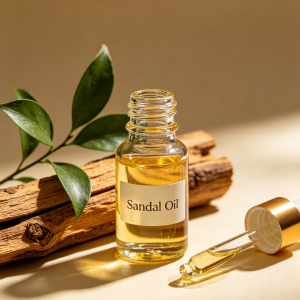
Product Attribute
| Product Name | Sandal Oil CAS:8006-87-9 |
| Type | Natural Flavor |
| Brand Name | BAISIFU |
| Appearance | Powder/Liquid |
| Shelf Life | 2 years |
| Specification | 1L |
| MOQ | 5kg |
| Origin | Shaanxi,China |
| Purity | 99% |
| Packing | Foil bag,Bottled,Drum,Carton,Container |
| Storage | Store in cool &dry place Keep away from strong light and heat |
| Ingredients | Natural raw materials, Safe and harmless, No addition |
<h1>Sandal Oil (CAS 8006-87-9) – Santalum Album Essential Oil</h1>
<h2>1. Introduction to Sandal Oil</h2>
First and foremost, sandal oil is a volatile oil.
Producers extract it from the heartwood of Santalum album (Santalaceae).
For one thing, it has a unique aroma.
For another, it has a wide range of practical uses.
Specifically, the main components of sandalwood oil are santalol and sandalic acid.
Additionally, it contains other terpenoids, alcohols, and esters.
As a result, these components give sandalwood oil its unique aroma and medicinal value.
Most importantly, santalol is the main active ingredient.
Notably, it delivers antibacterial, anti-inflammatory, and sedative effects.
<h2>2. Extraction Methods of Sandal Oil</h2>
<h3>2.1 Steam Distillation Method</h3>
To begin with, workers cut sandalwood heartwood into pieces.
Then, they put the pieces in a distiller.
Next, they introduce steam into the distiller.
Consequently, the volatile oil distills out with steam.
After that, workers cool the steam mixture.
Finally, they separate the oil from the condensed water.
<h3>2.2 Supercritical Fluid Extraction Method</h3>
Alternatively, producers use supercritical CO₂ to extract sandalwood oil.
First, they set specific temperature and pressure conditions.
Then, they run the extraction process under these settings.
In turn, this method achieves high efficiency.
Furthermore, it preserves more of the oil’s natural properties.
<h3>2.3 Solvent Extraction Method</h3>
First, workers cut and crush sandalwood into small pieces.
Next, they mix the pieces with a suitable solvent.
Afterward, they soak the mixture for a set period.
Then, they filter the mixture to remove solid parts.
Finally, they distill the filtered liquid to get the pure oil.
<h2>3. Key Application Fields of Sandal Oil</h2>
<h3>3.1 Medical Field</h3>
To start with, manufacturers use sandal oil in making Chinese and Western medicines.
In addition, they add it to drugs for insomnia, anxiety, and indigestion.
Moreover, researchers use it to develop new nerve-supporting drugs.
Additionally, they use it in anti-inflammatory drug research.
<h3>3.2 Fragrance Field</h3>
First, perfumers use sandal oil to blend perfumes and flavors.
This step creates a unique, long-lasting scent.
Besides, food producers add it as a spice in the food industry.
This practice boosts the flavor of many products.
<h3>3.3 Daily-Chemical Field</h3>
To begin with, brands add sandal oil to daily products like shampoo.
This gives the products a pleasant, long-lasting smell.
Furthermore, the oil may offer health benefits.
For example, it has antibacterial and anti-itch effects.
<h3>3.4 Religious Field</h3>
Lastly, people widely use sandal oil in religious ceremonies.
For instance, they use it in Buddha offerings.
Additionally, it plays a role in meditation and spiritual practices.